
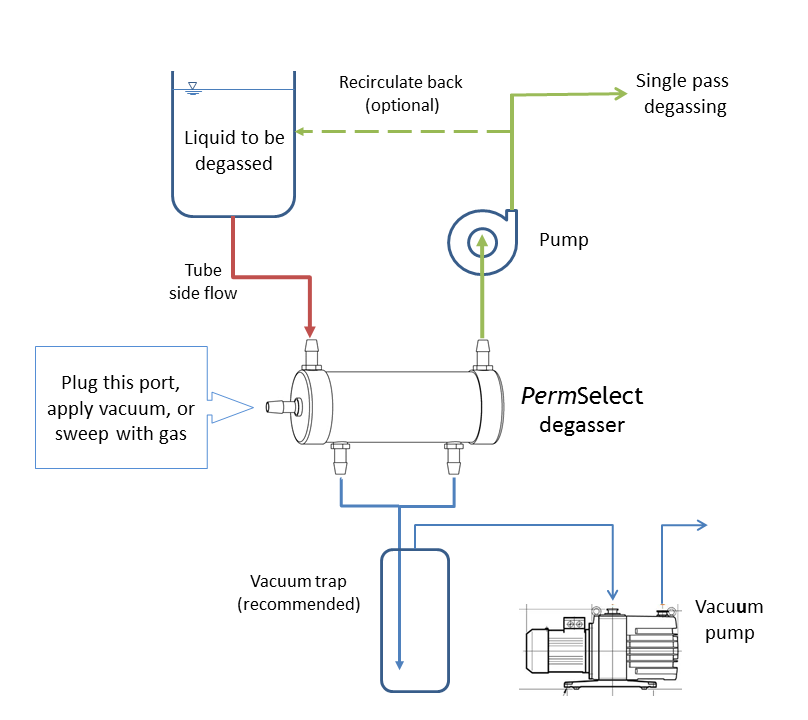
Why Degas Liquids?
Process liquids in many industries may contain dissolved gases which can form gas bubbles when the liquid temperature and pressure changes —typically when the temperature increases and the pressure decreases, or when exposed to ultrasonic waves. These gas bubbles can be problematic and undesirable as they can interfere with the process itself by affecting liquid flow consistency, process efficiency, detector sensitivity, analytical stability, and process quality. Thus it is may be beneficial to remove dissolved gases from (degas) liquids in certain processes.
Common gases dissolved in liquids are oxygen and nitrogen, the constituents of air which can be easily absorbed directly at liquid surfaces exposed to air, such as at the headspace of vessels containing the liquid.
What is liquid degassing?
Liquid degassing is the process of removing dissolved gases from liquids. There are several methods to degas liquids including:
- heating the liquid to reduce the solubility of the gas in the liquid thereby forcing gas bubbles to form and rise to the liquid surface
- applying vacuum to the liquid surface to reduce the liquid pressure, and force dissolved gases out of solution
- bubble sparging of an inert gas (such as nitrogen) in the liquid to replace the undesirable dissolved gas such as oxygen
- sonicating the liquid with ultrasonic waves to force dissolved gases to coalesce into bubbles that rise to the liquid surface
- in-line (continuous) membrane degassing in which the liquid is flowed through a membrane degasser where it comes in contact with one side of a gas permeable membrane (such as silicone), and a vacuum is applied to the other side of the membrane to draw dissolved gases from the liquid to the vacuum. Dissolved gases flow from a high partial pressure in the liquid side to a low partial pressure in the vacuum side, thereby reducing the total dissolved gas in the liquid.
All these methods, except for inline membrane degassing are typically conducted in a batch process whereas in-line membrane degassing is conducted in a continuous process. Moreover, in-line membrane degassing does not produce bubbles in the process of degassing the liquid like the other batch processes commonly do.
Degassing liquids with an in-line membrane degasser is a very effective method to degas a continuous flow of liquid. An in-line membrane degasser can remove or reduce dissolved gases thereby preventing gas bubble formation. It should be noted that in most processes it is not necessary to remove all the dissolved gases from the liquids to prevent bubble formation.
In-line membrane degassers are currently used in many processes including in the life sciences, water purification, energy production, and electronics manufacturing.
Liquid degassing in the Life Sciences
In-line membrane degassers are currently used in medical devices, bioprocessing equipment, in-vitro diagnostic equipment, HPLC and chromatography, drug and pharmaceutical filling & delivery, and microfluidics.
In-line membrane degassers have been used in medical devices which use ultrasonic waves for imaging and therapy, and where degassed water is needed as an ultrasound couplant to prevent undesirable bubbles. Examples include:
- 3D whole breast ultrasound (Breast Ultrasound Tomography (UST))
- Ultrasonic therapy (High-intensity focused ultrasound (HIFU), Histotripsy)
- Endodontic “Multisonic Ultracleaning”
Inline membrane degassers have also been used in diagnostic equipment such as for diagnostic sample preparation and flow cytometry.
In Biotech and Pharma membrane degassers are used in upstream processing (cell culture media CO2 removal), and downstream processing (purification, drug product filling), as well as for ultrapure water conditioning. Note that since membrane degassers are effectively gas exchangers, they can also be used for adding dissolved gases to liquids, and have been used for bubble free sparging (DO control) in cell culture bioreactors.
Background and Discussion
Oxygen, carbon dioxide, and other gases dissolved in water or other liquids can adversely affect many processes. Whether you are in the industrial, pharmaceutical, or semiconductor industry, delivering water that has very low levels of dissolved gases leads to longer equipment life, reduced maintenance, and improved process quality.
Our silicone membrane contactors, degassers (degassing filters), and deareators can be used effectively for continuous, flow-through vacuum degassing of liquids including high purity water, aerated water, low surface tension liquids, and many solvents. Indeed, our membrane degassers and deaerators are one of the most effective degassing methods available. Moreover, unlike other liquid degassing equipment and methods such as direct vacuum chamber degassing and ultrasonic water degassing -which are batch degassing approaches, membrane degassing using a PermSelect® degassing unit can be accomplished in a continuous flow-through mode. PermSelect® degassing units with silicone membranes can be used for:
| View a video demonstrating how to use a PermSelect membrane module to degas a liquid stream. |
How to remove dissolved gases from water and aerated water?
Water naturally contains dissolved gases, even after purification steps such as reverse osmosis and filtration. When water used for analytical or high purity processes contains dissolved oxygen and carbon dioxide, a number of problems can occur. Scientists and process specialists remove dissolved gases from water using liquid degassing equipment, including membrane degasifier systems, degassing units, and other batch methods such as vacuum degassing chambers. The benefits can be remarkable: reproducible results that meet experimental or regulatory requirements; lower downstream process intensity and longer component life; improved yields of materials in contact with degassed water; reduced issues with corrosion, undesired pH levels and unwanted byproducts
How to remove oxygen from water? Membrane degassing of water to remove oxygen avoids exposing oxygen-sensitive compounds to its effects, and reduces oxidation problems. Oxygen in the presence of other dissolved compounds, such as ammonia, can lead to other types of corrosion that affect piping and components. Dissolved oxygen and other gases can form bubbles, which may negatively affect processes and analytical measurements.
How to remove CO2 from water? In certain applications, such as ultrapure process water, removing CO2 is desirable to improve efficiency of other purification steps. A hollow fiber membrane degasser or deaerator (AKA, contactor) can efficiently remove the CO2, effectively as a CO2 scrubber and extend the life of components. Carbon dioxide in steam can form carbonic acid and carbonate in water, causing accelerated corrosion and affecting readings for pH and conductivity. Removing CO2 can positively affect the process results in applications from ultrapure water in semiconductor manufacturing to productivity in aquaculture.
How to degas Ink?
Dissolved gas and microbubbles in ink can significantly affect the speed and quality of printing. By interrupting droplet formation or pressurization at the ink head, dissolved gases can lead to improper jetting at the time of ink ejection. Beyond poor image quality, nozzle dropouts can cause expensive shutdown of the equipment, and the need for more frequent cleaning.
Degassing ink with a membrane degasser prior to it reaching the print head is a simple process. The ink flows through the degasser on one side of the membrane, while a vacuum is drawn on the other side. Gases dissolved in the ink readily transfer through the membrane to the vacuum side, leaving the ink degassed when it reached the outlet of the degasser.
For providers of ink in closed loop systems, a membrane degasser is used to degas the ink while filling the vacuum-sealed bags. Because the closed system does not allow air to contact the surface of the ink, as some bulk systems do, the need for additional degassing is minimized. This is especially important for white inks, which must be handled carefully to maintain suspension of the TiO2 pigment. In addition, degassing ink while packaging can reduce foaming, which otherwise will slow the fill process.
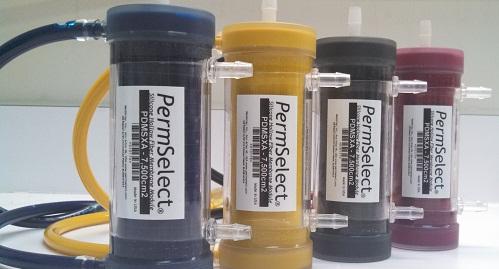
How to Degas Liquids using PermSelect® Membrane Contactors and Degassers?
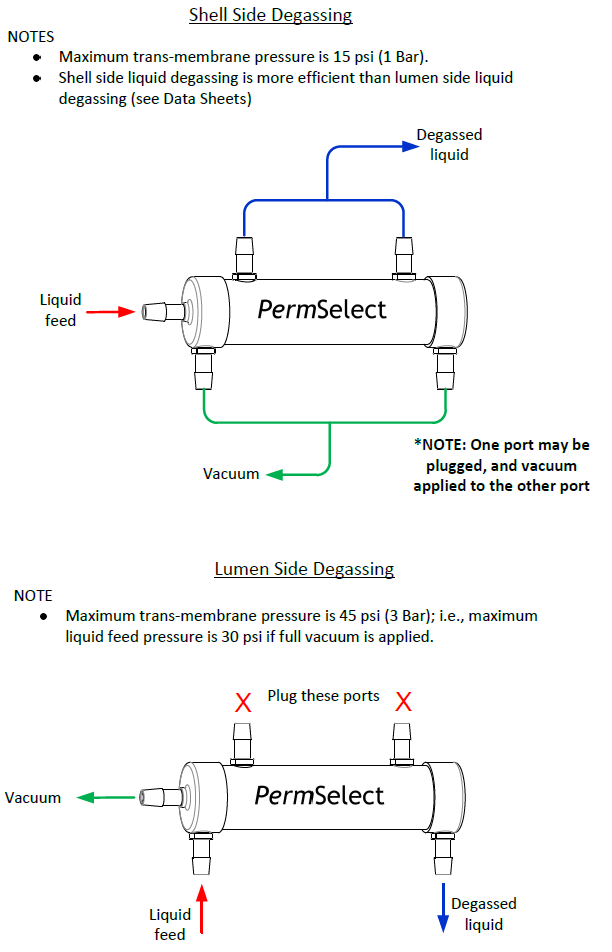
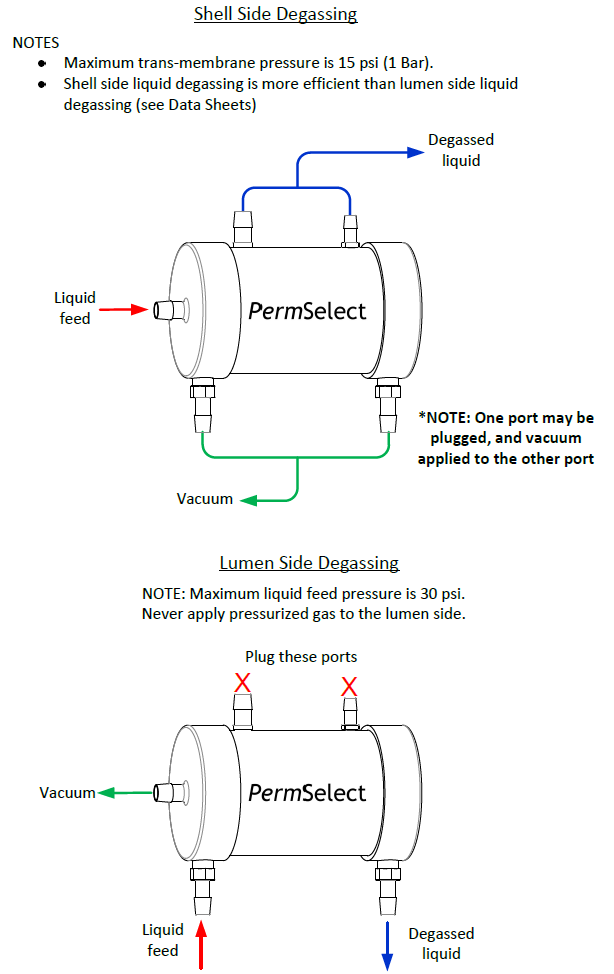
Degassing liquids using PermSelect® degassing filters and membrane contactors is straightforward as illustrated in the figure below. Liquid with dissolved gases is contained in a reservoir, or a continuous feed is supplied upstream from the membrane contactors or degasser. A pump may be placed in the circuit (upstream or downstream from the membrane contactor) if needed to provide a required flow rate through the system. The simplest method to degas a liquid is to use straight vacuum to remove all dissolved gases from the liquid. As shown in the figure below, liquid enters the center port of the PermSelect® membrane contactor, then flows on the outside of the hollow fibers (shell side) and exits the at side ports (shown on top of the module). Vacuum is applied at the ports on the end caps which provide vacuum to the inside (lumen side) of the hollow fibers. As liquid flows through the hollow fiber bundle, dissolved gases permeate the hollow fiber walls driven by the vacuum in the lumens. Extracted gases flow toward the vacuum pump and degassed liquid exits the side ports of the degasser.
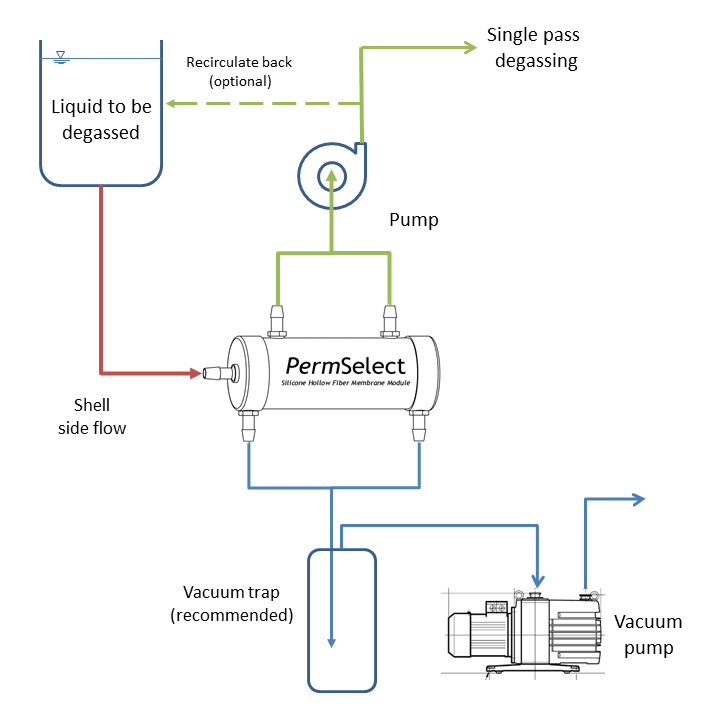
Liquid degassing can be accomplished continuously with a single pass through the degasser or membrane contactor or with multiple passes by recirculating the fluid through a reservoir. The choice will depend on the system design, the capacity of the degassing filter module to remove gases, and the required level of degassing. Other considerations include liquid-membrane compatibility, and the system fluid pressures. Please view the silicone chemical compatibility chart as an initial substance compatibility guide. Depending on your system pressure requirements, a swapping of liquid flow side and vacuum (a lumen side liquid flow) may be required. The maximum recommended trans-membrane pressure (TMP) for shell side liquid flow is 15 psi. So if your system exceeds this TMP then a lumen side liquid flow (as shown in the figure at the top of this page) is recommended up to 45 psi TMP.
Using PermSelect Silicone Membrane Contactors in Medical Devices and FDA Regulated Bioprocesses.
Our silicone membrane degassers and contactors are currently used in FDA regulated medical devices and bioprocesses, as well as by medical device and bioprocess designers and researchers. Our quality systems provide full material traceability, and each contactor and degasser is individually tested for integrity before shipping.
How to Remove Air Bubbles from Viscous Liquids and Gels?
Removing air bubbles from a viscous liquid can be challenging, but PermSelect® membrane degassers enable degassing and de-bubbling viscous liquids in a continuous manner, provided the viscous liquid can be driven (i.e., pumped) through the degasser without exceeding the membrane degasser's pressure specifications. Moreover, because our membrane modules can tolerate high temperatures, in many cases it is possible to increase the liquid temperature to decrease its viscosity, thereby allowing degassing and de-bubbling within the pressure specifications.
Recommended Membrane Module Connections for Liquid Degassing
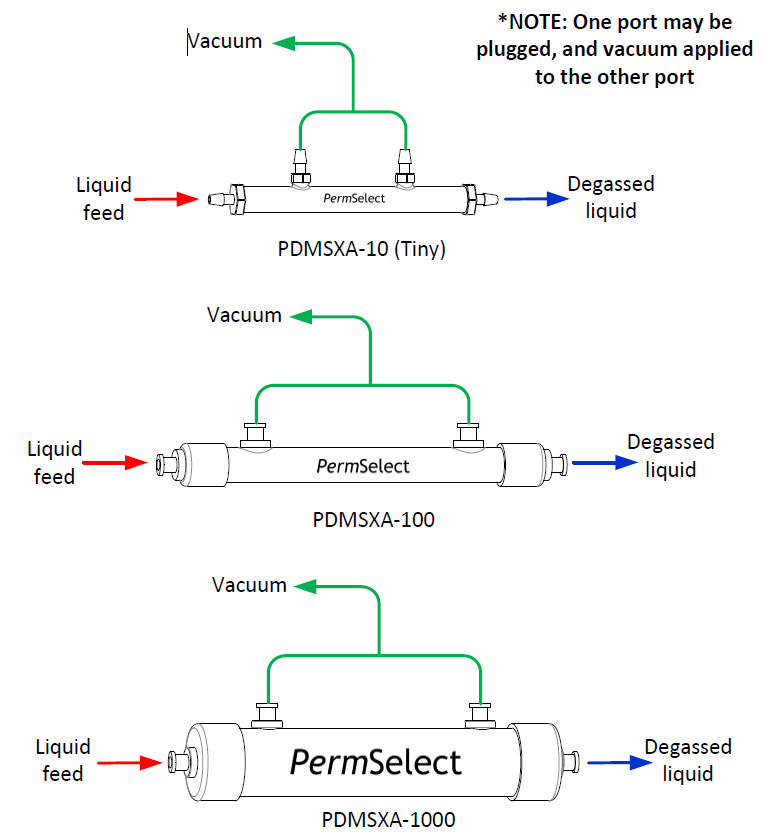
- PDMSXA-10 (Tiny), -100, -1000 (not recommended for shell side degassing)
Lumen Side Degassing
NOTE: Maximum trans-membrane pressure is 45 psi (3 Bar), i.e., maximum
liquid feed pressure is 30 psi if full vacuum is applied.
- PDMSXA-2500, -7500, -1.0
PDMSXA-2.1
Contact us to discuss your particular liquid degassing needs.
MedArray provides its PermSelect® membrane contactors and degassers for vacuum liquid degassing directly to researchers, and to industry through original equipment manufacturers (OEM’s) who are interested in integrating degassing solutions in their equipment. We can also customize membrane modules to your specific volume application. Contact us to discuss your custom application.